HARVEST • JUNIOR DISCIPLES
Find six hidden objects
Tap six things that did not belong in Bible times.
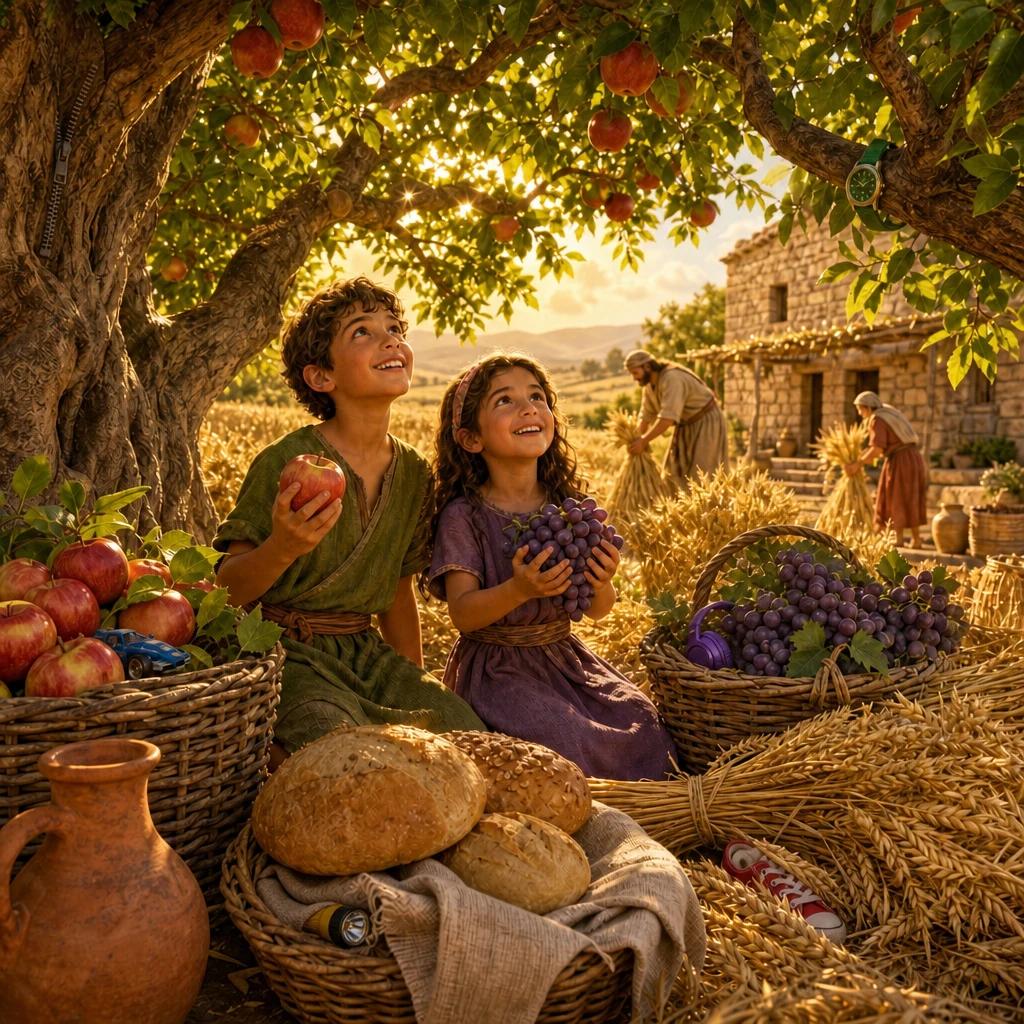
Found: 0 / 6
BEWARE!
Have you ever been so excited about a present that you forgot to say thank you? Michael has. His new toy car helps us think about something bigger: how to stay close to God when life is good.
Memory verse“then take care lest you forget the LORD, who brought you out of the land of Egypt, out of the house of slavery.”
Deuteronomy 6:12 · ESV
Parent & teacher guide
When everything is going well • Junior Disciples • Ages 6–11 • 35–40 minutes
Download the printable: LETTER, landscape, duplex — flip on the LONG edge. Fold in half.
English printable (PDF) · Russian printable (PDF)
The land promise was for Israel; it does not promise every child wealth. God is faithful in hard days too. This particular judgment in Daniel does not mean illness or disability proves personal sin. God’s jealousy is His holy claim to covenant faithfulness, not envy. Do not compare possessions or require public confessions. Children may point, draw, speak, or pass. The harvest art is an imaginative activity scene, not a historical reconstruction. English Scripture: ESV; Russian: Synodal. Daniel’s verse numbers differ between these translations.
Read the Bible passage: Deuteronomy 6:12 · ESV ↗Optional, after the three dangers: read the short Jack Whittaker example and ask, ‘If you had every game you wanted, what would you still need God's help to do?’ Invite one example, such as sharing or stopping to help. The interview supports his wish to help others and his later regret; it does not establish that he abandoned God. Money is not evil, and obedience does not guarantee wealth. This source includes adult material; do not read it aloud or show it to children. Keep to the brief lesson example.
Adult source: Jack Whittaker interview, ABC News, April 2007 ↗A present—and a person
1 • Begin together • 5 minutes
Ready to lead
Purpose: When life is good, children will recognize three main dangers: forget God, reject God's authority, and replace God with His gifts. Teach the response: Remember Him. Listen to Him. Put Him first. Jesus is our greatest treasure; He gives forgiveness and eternal life to those who trust Him. The concluding theme is not a Bible quotation. Earthly life and good gifts are valuable, not evil. Gratitude does not earn grace. Bring a Bible, toy car or drawing, pencils, paper, and cards: Boast, Humbled, Praise.
Our route
Allow 5 minutes for this opening, 7 for Moses and the memory verse, 6 for the three dangers, 6 for the king and Jesus, 8 for activities, and 3–8 for response and prayer. The shorter route takes 35 minutes; use extra time for children's questions, not extra lectures.
Say: Meet Michael
Tell this made-up story: ‘Grandma gives Michael a little red toy car. He takes it out of the box and races it across the table. Vroom! Grandma is sitting right beside him, but he's too busy playing to look up. Rosie asks, “Michael, did you say thank you to Grandma?” Michael stops and looks at Grandma. “Oh! Thanks, Grandma. I love it!” Then he holds the car out to Rosie. “Want a turn?”’
Ask and discover
Hold up the car. Ask: ‘Was it wrong for Michael to enjoy his new car?’ Sample answer: ‘No. He just forgot to thank Grandma.’ Say: ‘Grandma wanted him to enjoy it! But he got so busy playing that he forgot to say thank you. We can forget to thank God, too, especially when everything is going well. In today's Bible passage, God's people are about to have homes and plenty of food. Listen to what Moses tells them.’ Invite each child to name one good thing they enjoyed today, then open the Bible.
Remember who rescued you
2 • Moses speaks • Deuteronomy 6:10–15 • 7 minutes
Say: A promise kept
Bible retelling: God promised Abraham a land for his family and the generations after them. He made that same promise to Isaac and Jacob. Many years passed, but God did not forget. The Israelites were slaves in Egypt, and they could not free themselves. God rescued them and led them through the wilderness. Now they were about to enter the land he had promised. Moses had something important to tell them.
Look at the gifts
Continue the retelling: God would give them large towns they hadn't built and houses already full of good things. There would be wells they hadn't dug, vineyards and olive trees they hadn't planted, and enough food to eat. They had so much to look forward to. But Moses warned them: when they had all these things, they must not forget the God who rescued them or start following other gods.
Read: Our memory verse
Deuteronomy 6:12 (ESV): ‘then take care lest you forget the LORD, who brought you out of the land of Egypt, out of the house of slavery.’ Read slowly, then invite children to echo short phrases. Explain: ‘Take care means pay attention. The LORD is the God who rescued his people.’
Ask: Why the warning?
Ask: ‘Who freed the Israelites from slavery?’ Answer: ‘God did.’ ‘Would they still need God once they had homes and enough food?’ Answer: ‘Yes.’ Say: ‘Michael got so busy with his car that he forgot to thank Grandma. God's people could get busy enjoying their new homes and forget him, too. Remembering God means trusting him and obeying him as Lord, not just knowing his name.’ Teacher: God promised this land to Israel. This passage does not promise every child a wealthy home. God is faithful when life is hard, too.
Three main dangers when life is good
3 • Heart, deeds, and words • 6 minutes
Forget God → Remember Him
Say: ‘Before Rosie spoke to Michael, he was so busy playing that he forgot to thank Grandma. We can enjoy the things God gives us and never thank him or think about him. Moses isn't warning us about having trouble remembering a name or a verse. He's warning us not to live as if God doesn't matter.’ Ask: ‘What did Michael do when Rosie reminded him?’ Sample answer: ‘He stopped and thanked Grandma.’ Ask: ‘What could you thank God for today?’
Reject God's authority → Listen to Him
Say: ‘Imagine Michael knows it's time to stop playing and help, but he refuses. Or he breaks the ramp Rosie built for the cars and says he didn't. He knows what's right. He just doesn't want to do it.’ Bible retelling, Deuteronomy 6:13: Moses told God's people to honor and serve the Lord. Say: ‘God has the right to tell us how to live. We can't say we respect him and then refuse to obey him. That includes what we do and what we say.’ Ask: ‘What should Michael do about the broken ramp?’ Sample answer: ‘Tell the truth, say sorry, and help fix it.’
Replace God with His gifts → Put Him first
Bible retelling, Deuteronomy 6:14–15: Moses warned Israel not to follow other gods. The Lord is holy and jealous for his people's faithfulness. Say: ‘Jealous here doesn't mean wanting someone else's toy. God had made a covenant with his people, a binding promise. He was faithful to them, and they belonged to him. He rightly required them to worship only him. Worshiping other gods is a serious sin. God judges it.’
Ask: Is the car the problem?
Ask: ‘Is it wrong to enjoy a toy or want to win a race?’ Sample answer: ‘No.’ Say: ‘But suppose Michael is willing to lie or hurt someone just to win. Then he cares more about winning than obeying God. We can treat even good things as more important than God. That's how we replace God with his gifts. These three dangers often happen together. We need to turn back to God and ask for his help. Listen to what happened to a king who thought he didn't need God.’
The king who looked up
4 • Bible retelling: Daniel 4:28–37 • 6 minutes
Say: From boasting to helplessness
Daniel had already warned King Nebuchadnezzar to turn from sin and show mercy to the poor. A year later, the king walked on the roof of his palace in Babylon. He looked at his great city and boasted about his own power and glory. He acted as though everything depended on him. While he was still speaking, a voice from heaven announced that his kingdom was taken from him. God rules over human kingdoms, even over their strongest kings.
A serious humbling
The warning came true. The king could no longer think clearly or rule. He lived away from people, outside among animals, and ate grass. This was God's serious judgment on his pride, not a funny game. At the end of that time, he lifted his eyes toward heaven. His understanding returned. He praised the living God, whose rule lasts forever. His kingdom was restored. Now he honored God instead of boasting in himself.
Ask: What changed?
Ask: ‘The king had a palace and a powerful kingdom. Who did he give the credit to?’ Answer: ‘Himself.’ ‘Was anyone greater than the king?’ Answer: ‘Yes, God.’ ‘What did the king do when his understanding returned?’ Answer: ‘He praised God.’ Say: ‘He had acted as if he didn't need God. He ignored God's authority and cared most about his own greatness. Having success wasn't the sin. His pride was. We still need God when things are going well, and we still need to obey him.’
Good news when we fail
Say: ‘We've all put ourselves first and disobeyed God. We need his forgiveness. Just learning to say thank you won't take away our sin. Jesus, God's Son, lived without sin, died for our sins, and rose again. We can turn from sin and trust him. He saves us by grace. That means his salvation is a gift we cannot earn. We thank him because he is kind to us, not to earn his forgiveness.’ This is a gospel summary, not a quotation (1 Corinthians 15:3–4; Ephesians 2:8–10). Teacher: This judgment on the king does not mean that illness or disability proves someone has committed a particular sin.
Spot the danger. Choose your response.
5 • Look, choose, and retell • 8 minutes
Do: Find three gifts
Read Deuteronomy 6:10–11 together. On blank paper, draw or name three gifts Moses described: a house in the town, a well, and a grapevine. Tell a partner how each helps people. Sample answers: shelter, water, food. Ask who promised these gifts to Israel. Answer: God. Children may point, speak, or draw; no supplied illustration is needed.
Choose: Pause the game
Say: ‘Michael agreed to help tidy up after playing. Now it's time, but he wants one more race. What could he say?’ Let partners suggest a response, then act it out. Sample: ‘Okay, I'll put the car away. What needs tidying?’ Ask: ‘Was it wrong to enjoy the race?’ Answer: ‘No. But wanting to play isn't a reason to break his promise.’
Choose: Tell the truth
Read each thought and ask which danger it shows: ‘I don't need God’ — forgetting God. ‘I know what God says, but I won't do it’ — rejecting God's authority. ‘I'll do anything to win, even disobey God’ — replacing God with his gifts. Ask what the child could do instead. Then try this scene: Rosie helped Michael build a ramp. Someone says, ‘Michael, did you build that all by yourself?’ What should he say? Sample: ‘Rosie helped me!’ We can thank God for what we can do and be honest about the help we receive.
Choose: Welcome someone
Say: ‘A new child asks to play. Michael's friends say, “If you let him play, we're not playing with you.” What could Michael say?’ Sample: ‘He can play with us. Come on, let's build another ramp.’ Ask: ‘What matters more: pleasing his friends or doing what God says is right?’ Sample answer: ‘Doing what God says is right, even if his friends are upset.’ Keep the example made-up; don't ask children to name classmates.
Do: Put the king's story in order
Mix the cards Praise, Boast, Humbled. Children arrange them: Boast → Humbled → Praise. Ask each child to retell one moment. Then ask: ‘Can thank-you words earn forgiveness?’ Answer: ‘No. Jesus saves us by grace.’ Say: ‘Now let's bring this lesson back to Michael—and home with us.’
Jesus Is Better Than Life!
6 • Respond, pray, and take it home • 3–8 minutes
Say: Michael's next choice
Say: ‘Michael still loves his red car. He can enjoy playing and still thank Grandma, let Rosie have a turn, and invite someone else to join in. When Rosie helps him, he can say so. He doesn't have to get his own way every time to have fun. We can enjoy what God gives us and still obey him.’ Ask: ‘What's something you enjoy? How could you thank God for it or share it with someone?’ Accept simple answers without comparing possessions.
Do: One small response
Ask children to choose one of the three dangers: forgetting God, refusing to obey him, or treating his gifts as more important than he is. They can name it or draw an example. Ask: ‘What could you do differently today?’ Examples: thank God, tell the truth, or stop playing when it's time to help. Let children pass. Repeat Deuteronomy 6:12. Say: ‘Jesus gives us forgiveness and eternal life. Being comfortable or successful can't give us that. Jesus matters more than anything else we have. Our life is a good gift from God, and we can enjoy it. We ask Jesus to help us obey him. We don't have to earn his love.’
Pray together
‘Father, you are good and faithful. Thank you for your gifts and for Jesus. Forgive us for putting ourselves first. Help us trust Jesus, remember you, tell the truth, and love others. Keep our hearts faithful to you in happy days and hard days. Amen.’ Children may listen or join freely.
Take it home
At a meal or bedtime, show your drawing to an adult you trust. Read Deuteronomy 6:12 together. Ask each other: ‘What can we thank God for today? Is there something we need his help to do tomorrow?’ Thank someone who helped you, too.
Facilitator key and adaptations
Key: God rescued Israel; house/well/vine mean shelter/water/food. Pause play; credit Rosie; welcome the newcomer. King: Boast → Humbled → Praise. Jesus' grace, not gratitude, saves. Ages 6–8: read aloud, use gestures, accept pointing. Ages 9–11: ask why each choice shows trust. Offer drawing or private answers; avoid forced confessions. Never equate fewer possessions with less faith or less of God's love.